

Connect five stones in a row to win!
Play Gomoku Online - Five in a Row with Friends
Gomoku is a 2-player strategy board game where each player tries to connect five of their Go stones in a row. The game, which is played on a Go board, is also known as "Five in a Row."
The game's origins can be dated back to approximately the 18th century. It has its origins in Japan. Since then, Gomoku has gained popularity over the centuries and is now considered a popular board game.
Here you can play the game online with your friends. Create a room now or join an existing game. Have fun!


Rules of Gomoku
The game is played on a 15x15 Go board. Each player has white or black Go stones available, which are placed alternately. The goal is to be the first to connect five stones - horizontally, vertically, or diagonally.
As the name suggests, Gomoku uses a Go board. This board is 15x15 squares. The special feature is that the game pieces are not placed in the squares, but on the intersection points.
The game pieces themselves are Go stones. They are white or black in color. The player with the black stones starts the game. Now each player can alternately place one of their Go stones on an empty intersection point.
The goal of the game is to be the first to connect five stones in a row. This can be done horizontally, vertically, or diagonally. The player who first connects five stones in a row wins the game. If all squares are filled without a five-in-a-row, the game ends in a draw.
The following image shows an example of a Gomoku game:
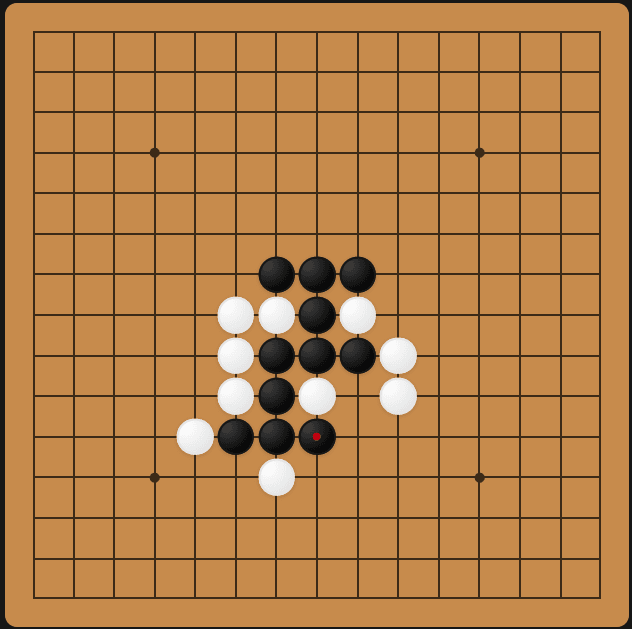
In the image above, a red marker is visible. This indicates the stone that was placed last.
Gomoku Variants
Gomoku itself is considered a solved game. This means that the starting player always wins if they play optimally. This comes into play in the classic "Freestyle" variant, as no additional rules apply beyond the usual game rules.
For this reason, there are a number of variants that make Gomoku a bit more complex. Two of these variants are presented here.
Renju
Renju compensates for the starting player's advantage. While they can still win with a five-in-a-row, they can lose the game through forbidden moves. These include two three-in-a-rows, two four-in-a-rows, or a six-in-a-row. In addition, there is a specific opening that must be followed.
Pente
Pente is played on a 19x19 Go board. The special feature is that a player can remove two opponent's stones from the board by surrounding them. The winner is the player who first has five stones in a row or can capture five times.
Strategies and Tips
Place your stones centrally, block opponent's four-in-a-rows, and create double threats to maximize your chances of winning at Gomoku.
There are numerous tips and strategies to improve your own Gomoku game. Three of these tips are presented here.
1. Control the Center
The center of the board allows you to form winning rows in all directions. Therefore, you should place your stones in the center at the beginning of the game and not give up the center to your opponent during the course of the game.
2. Block Four-in-a-Rows
A four-in-a-row describes four connected stones. They pose a particular threat because they can potentially form a five-in-a-row on both sides. So if you see a three-in-a-row, you should block it to prevent a four-in-a-row.
3. Create Double Threats
A double threat describes a game situation where a player has two winning opportunities. They can form a five-in-a-row at both ends.
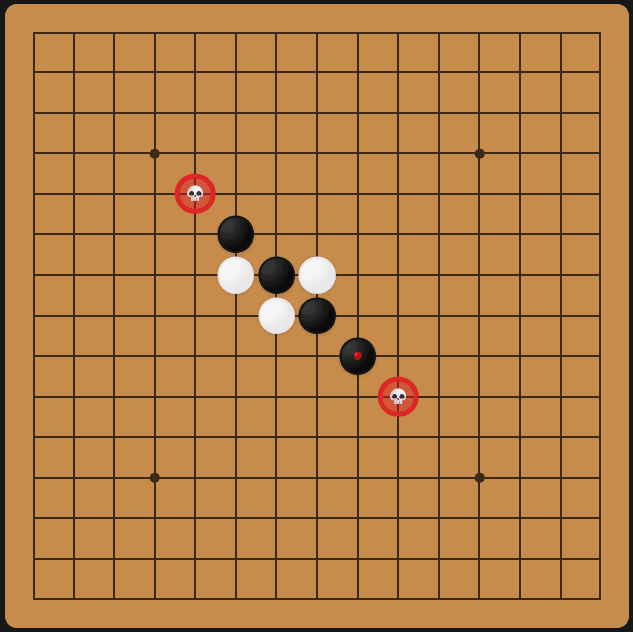
In the example above, the black player can achieve a five-in-a-row on their next move through their double threat. The white player can only block one side and thus loses the game.
Questions and Answers
Challenge a friend now and play Gomoku online.